


Pool closing
Get your pool and equipment ready for winter. Our team handles your pool closing to protect it from freezing damage.
Book your pool closing
THE ADVANTAGE AND EXPERTISE OF
PISCINES ET SPAS POSÉIDON

SPECIALIZED
POOL TECHNICIANS
Our team follows a thorough process tailored to the various components of your pool.

Better protection
for your pool system
Winterizing equipment and plumbing helps prevent freezing damage.

Hassle-free
pool closing
Avoid missed steps and save time by letting our technicians handle the main stages of your pool closing.
Our technicians carefully close your pool before the first frost
Book your closing in advance to secure an appointment before freezing temperatures arrive.
Our technicians handle the main steps of winterizing your pool. They remove accessories, prepare equipment and add the necessary products to reduce the risk of freezing damage.
Closing your pool at the right time prepares it for winter and makes it easier to restart in the spring.
Save time and benefit from our technicians’ expertise
Closing your pool takes time, precision and a good understanding of your equipment.
Our specialized technicians winterize your pool with a methodical approach and expert know-how. You save time and enjoy autumn with peace of mind, without worrying about the closing process.

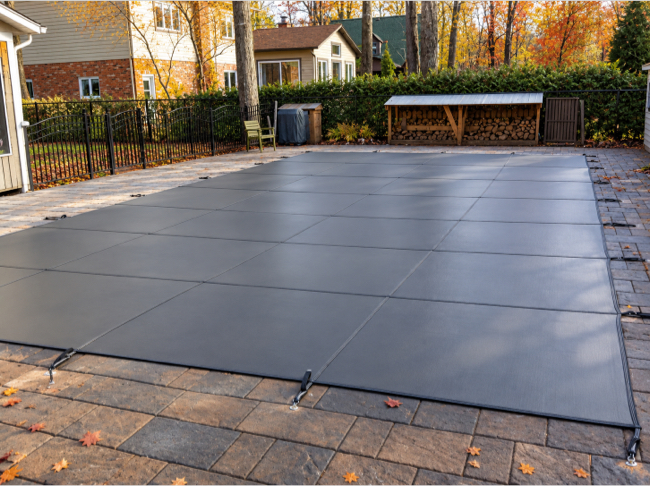
Protect your pool from freezing and avoid costly damage.
A pool that is not properly prepared for winter can suffer freezing damage: cracked pipes, damaged fittings, a broken skimmer or damaged equipment. Some of these problems are only discovered when the pool is opened in the spring.
Thorough winterization helps protect your pool and equipment throughout the winter while making them easier to restart in the spring.
Entrust your pool closing to our specialized technicians to reduce the risk of damage and unpleasant surprises in the spring.
Our pool closing service
No time to close your pool?
Our certified professional technicians take care of everything.
What is included in a pool closing?
Every pool setup is different, so our technicians tailor the closing process to your pool’s equipment.
Closing services available for:
- Vinyl-lined in-ground pools
- Fibreglass in-ground pools
- Concrete in-ground pools
- Above-ground pools
POOL CLOSING SERVICES
Depending on the type of pool and the equipment installed, the service may include:
- Winterizing the plumbing;
- Winterizing the skimmer;
- Preparing the filter and pump;
- Removing certain accessories;
- Winterizing the skimmer;
- Winterizing the equipment;
- Adding the chemicals needed for closing;
- General preparation of the pool for winter.
How should you prepare your pool before our visit?
A few preparations can make the technician’s work easier and help the service go smoothly.
Before we arrive:
- Make sure the pool and equipment are accessible;
- Remove personal items from around the pool;
- Check that access to the power supply is clear
- Have the accessories needed for closing ready, if applicable;
- Let us know about any issues or leaks noticed during the season.
Instructions specific to your pool setup can be confirmed when you book your appointment.
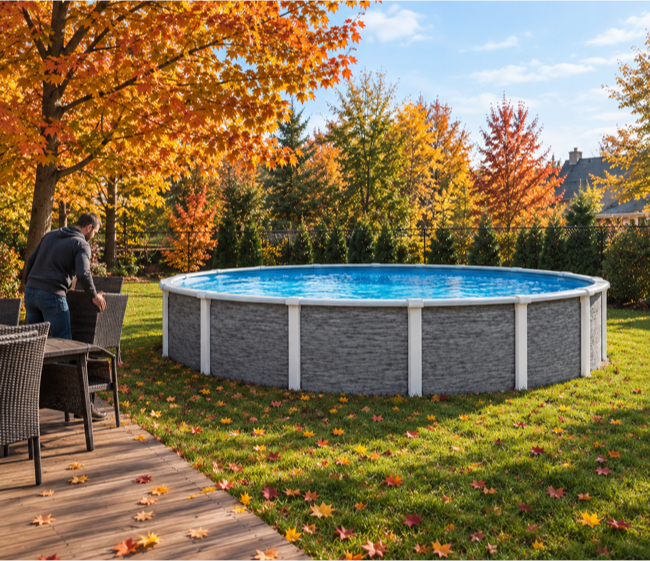
Everything you need to know about our pool closing service
When should you close your pool in Quebec?
It is generally recommended to close your pool in the fall, once the swimming season is over but before prolonged freezing temperatures arrive.
Do not wait until the pipes and equipment start to freeze. Closing at the right time allows the plumbing and equipment to be properly winterized while preparing the pool for the winter months.
At Piscines et Spas POSEIDON, we recommend booking your closing in advance, as pool closing season is particularly busy.
Why is it important to properly close your pool for winter?
A proper pool closing primarily protects the plumbing, filtration system and various pieces of equipment from freezing damage.
Water expands when it freezes. Water left in a pipe, pump, filter or heater can therefore cause significant damage during the winter.
A proper closing protects your investment and also makes it easier to get your pool running again in the spring.
Do you close in-ground and above-ground pools?
Yes. Piscines et Spas POSEIDON closes several types of pools, including in-ground, semi-in-ground and above-ground pools.
We can also close vinyl-lined, concrete and fibreglass in-ground pools.
The winterization process is tailored to the type of pool and the equipment installed.
What is the difference between closing an in-ground pool and an above-ground pool?
The principles are similar, but the techniques used may differ.
An in-ground pool generally has more underground plumbing and may include a main drain, several return jets, lights, a spillover spa or other equipment that must be properly winterized.
An above-ground pool has a different setup and also requires special attention to the skimmer, return jets, filtration system and accessories.
In both cases, the goal remains the same: to protect the pool and its equipment from freezing.
Why do pool lines need to be blown out?
Even when the pool’s water level is lowered, water can remain trapped in the plumbing.
Blowing out the lines removes this water to reduce the risk of it freezing and damaging the pipes during the winter.
This step is particularly important for in-ground pools, since many lines are underground and can be difficult and costly to repair if damaged.
What can happen if a pool is not closed properly?
Improper winterization can cause significant damage.
Water left in the wrong place can lead to cracked pipes, damaged fittings, a broken skimmer or damage to the pump, filter, heater and other equipment.
Some damage only becomes visible when the pool is opened in the spring.
This is why closing is one of the tasks for which hiring a specialized technician can be particularly beneficial.
Do I need to be home when my pool is closed?
No. In most cases, you do not need to be present.
As long as our technicians have access to the pool, equipment and necessary accessories, they can close your pool while you are away.
If there is anything unusual about your pool setup, we simply recommend letting us know before the visit.
Do chemicals need to be added when closing the pool?
It is best for the pool to be reasonably clean before closing.
Removing leaves and debris helps maintain better water quality throughout the winter and can make opening easier in the spring.
Depending on your situation and the service selected, our team can let you know what needs to be done before we arrive.
Should I clean my pool before closing?
It is best for the pool to be reasonably clean before closing.
Removing leaves and debris helps maintain better water quality throughout the winter and can make opening easier in the spring.
Depending on your situation and the service selected, our team can let you know what needs to be done before we arrive.
Does the water level need to be lowered for winter?
This depends on the type of pool, its lining and the winterization method used.
The required water level for a vinyl-lined in-ground pool may differ from that of a concrete, fibreglass or above-ground pool.
It is important not to simply drain a pool without knowing the proper procedure. Our technicians adjust the water level according to the type of pool setup.
Should a pool be completely drained for winter?
No. In the vast majority of cases, a pool should not be completely drained for winter.
Water plays an important role in supporting certain structures and linings. Completely draining a pool unnecessarily can cause problems.
This is particularly important for certain fibreglass and vinyl-lined pools, as well as installations where pressure from surrounding groundwater must be taken into account.
Do you close pools equipped with a saltwater system?
Yes. Saltwater pools also need to be winterized.
The salt cell and the various system components must be properly prepared for winter. The procedure depends on the model and the configuration of the installation.
Our technicians take the saltwater system into account when closing your pool.
Do you also winterize the heat pump or pool heater?
Yes. Heating equipment must be properly prepared for winter.
A heat pump or pool heater that still contains water can be damaged by freezing. Our technicians take the equipment in your pool setup into account during closing.
What if my pool has a spillover spa?
A spillover spa adds plumbing, jets and various components that must also be winterized.
Our technicians adapt the closing procedure to protect both the pool and the spillover spa, along with its lines, from freezing.
It is important to let us know about a spillover spa when booking your appointment.
Can you close a pool with an automation system?
Yes. We work with many types of pool equipment, including automation systems, saltwater systems, pool heaters, heat pumps, UV systems and various filtration setups.
Each piece of equipment is taken into account so that the entire installation is properly prepared for winter.
Should the pool ladder and accessories be removed?
Yes. Ladders, steps and certain accessories must be removed depending on the type of pool.
Leaving steps in the pool during winter can create a risk of damage as ice forms and shifts.
Removed accessories should then be cleaned and stored in a suitable place for winter.
What should I do with my solar cover during winter?
The solar cover must be removed before winter.
We recommend cleaning it, letting it dry thoroughly and then storing it in a dry, sheltered place. A solar cover left outside or stored while damp may deteriorate prematurely.
Should I install a winter cover on my pool?
A winter cover or mesh cover may be strongly recommended depending on the type of pool and its surroundings.
Winter protection helps reduce the amount of leaves and debris that end up in the pool and can make cleaning much easier when opening in the spring.
Our team can advise you on the type of protection best suited to your pool.
What should I do with my pool during winter?
Even after a professional closing, it is recommended to check on your pool occasionally.
Make sure winter protections remain in place, and watch for heavy snow buildup or anything unusual.
Also avoid walking on the ice or on a cover that is not designed to support a person’s weight.
Should I break the ice that forms in my pool?
No. You should generally not try to break the ice in a pool.
Striking the ice can damage the liner, walls or certain accessories. It is best to let the ice melt naturally and contact a professional if you notice anything that concerns you.
Does a professional closing make spring opening easier?
Yes. A properly winterized pool is generally much easier to get running again in the spring.
A proper closing protects equipment, limits freezing-related problems and prepares the pool so that opening goes as smoothly as possible.
Closing and opening are therefore two complementary steps in extending the life of your pool.
Why should I have a professional close my pool?
Closing a pool involves several technical steps, and a mistake can lead to major repairs.
A professional has the equipment and experience needed to properly winterize the plumbing, filtration system and various accessories in your pool setup.
This is particularly beneficial for complex in-ground pools with several return jets, a saltwater system, a heat pump, a pool heater, an automation system or a spillover spa.
Why choose Piscines et Spas POSEIDON to close my pool?
Piscines et Spas POSEIDON has specialized in pool maintenance and service for over 25 years.
Our technicians close in-ground, above-ground and semi-in-ground pools and have the experience needed to winterize the various pieces of equipment found in a modern pool setup.
Our goal is simple: to protect your pool and equipment from the harsh Quebec winter so that everything is in good condition when spring arrives.
Get your pool ready for winter with Poseidon
Do not let the first frost catch you off guard. Entrust your pool closing to specialized technicians and protect your pool and equipment for the winter season.
