


Noticing that your pool water level is dropping quickly can be concerning, but the cause is not always serious. Evaporation, splashing, an actual leak or equipment failure: each situation has its own signs and solutions. Here is how to identify the source of the problem before taking action.
What is normal water loss for a pool?
A pool naturally loses water every day, especially in summer. Typical values in Quebec are:
Normal evaporation: between 0.5 cm and 2 cm per day.
Heat waves or strong winds: up to 3 cm per day.
Splashing and frequent swimming: an additional 1 to 2 cm per day.
Water loss greater than 3 cm per day, without swimming or a heat wave, should be investigated more thoroughly.
Step 1: Do the bucket test
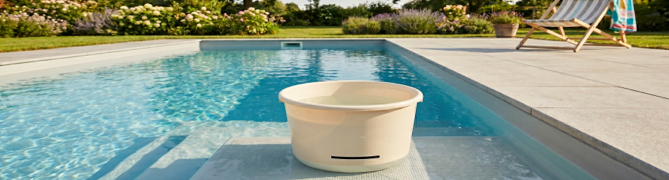
The bucket test helps quickly determine whether the water loss is caused by evaporation or an actual leak. Here is how to do it:
Fill a bucket with water and place it on the first step of the pool, partially submerged.
Mark the water level inside the bucket and the water level of the pool.
Wait 24 hours without using the pool or running the system.
Compare the two levels.
If the water has dropped equally in the bucket and in the pool, it is evaporation. If the pool has lost more water than the bucket, there may be a leak somewhere.
Step 2: Repeat the test with the pump running
To help identify the source of a leak, repeat the bucket test for 24 hours with the filtration system running. The results can provide a useful clue:
More water loss with the pump running: the leak is probably coming from the pressure-side plumbing, meaning the return line.
More water loss with the pump off: the leak is likely coming from the suction-side plumbing or directly from the pool basin.
Equal water loss in both cases: the leak is probably in the structure itself, such as the liner, a crack or a seal.
Step 3: Inspect common leak points
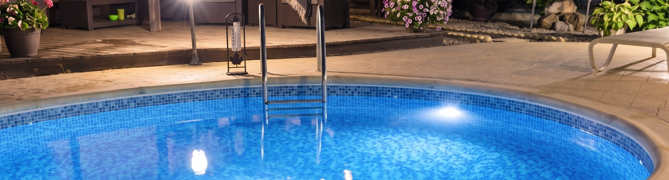
Several areas should be visually inspected before assuming there is a major problem:
Skimmer and return jet seals: cracks, scale buildup or detachment.
Pool lights: worn watertight seal.
Pool liner: tears, punctures or suspicious folds.
Ladder, steps and accessories attached to the pool basin.
Ground around the filtration system: persistent wet area.
For an in-ground concrete or fiberglass pool, visible cracks should be inspected quickly by a professional.
Step 4: Check the filtration system
A leak may also come directly from the equipment. Signs to watch for include:
A puddle of water under the filter or pump.
Dripping around the fittings.
A visibly worn filter O-ring.
A pressure gauge that drops abnormally.
Important: any work on pressure-side plumbing, the pump or the water heater should be handled by a technician. Improper handling can worsen the leak, damage the system or create an electrical hazard. A visual inspection is safe, but disassembly is not.
A pool repair service can accurately locate the leak using specialized equipment.
Step 5: Special case: fiberglass pools
Fiberglass pools require special attention. The basin must remain filled at all times, even during the off-season, to prevent lifting caused by hydrostatic pressure from the ground.
Major water loss in this type of pool can lead to costly structural damage. A fiberglass pool repair service or fiberglass repair should be contacted quickly.
Step 6: Check the liner for above-ground pools and in-ground pools with a liner
For pools with a liner, water loss may indicate a puncture, a failing seal or a liner that is nearing the end of its life. Areas to inspect include:
Folds and seams.
Around the skimmer and return jets.
The bottom of the pool near the steps.
If the liner shows signs of general wear, replacing the pool liner may be more cost-effective in the long run than repeated repairs.
Preventing water loss
A few simple habits can help limit unnecessary water loss:
Use a solar cover to reduce evaporation by up to 90%
Maintain proper water chemistry to protect the seals
Inspect seals and accessories at the beginning of the season during pool opening
Perform regular pool maintenance
Complete a proper pool closing at the end of the season
Need a professional diagnosis?
An unidentified leak can lead to a higher water bill, constant chemical imbalance and, in some cases, damage to the surrounding ground or pool structure. The team at Piscines & Spas POSEIDON offers leak detection and repair services for all types of pools in the Greater Montreal area and on the South Shore. A quote request can be submitted online.
